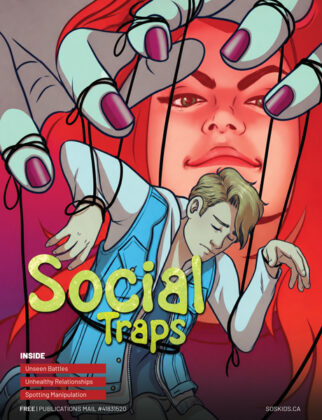
SHARE
RECENT

The Manosphere: Who’s Shaping Young Men’s Views on Masculinity?
While reading an article about the manosphere, I came across Pierce’s story. In 2019, he was 24, between jobs and struggling with depression. He wanted to feel more confident and find a sense of belonging.…
How to Spot Manipulation: Hidden Signs and Unhealthy Patterns
Have you ever wondered if you're experiencing manipulation, but ignored the feeling that something wasn't right? Maybe you've noticed someone making you feel guilty for saying no, dismissing your feelings or blaming you for every…

When Did Having a Phone Become a Necessity?
“But my friend already has a phone.” For a lot of kids, that might be one of the first arguments they make when asking their parents for their own phone. And honestly, it can be…

Are You Choosing Your Feed, or Is It Choosing You?
Today, the people you spend the most time with aren't always sitting in your living room or standing on the court with you. Some of them live inside the glass screen in your pocket. And…
1 in 2 Men Are at Risk. Are you?
More than six out of every ten Canadian men aged 19–29 are at risk of social isolation, the highest of any age group surveyed in the Canadian Men’s Health Foundation's 2025 research. And social isolation…
I NEED HELP: TEEN SUICIDE PREVENTION, MENTAL HEALTH
Personal Trauma Still-in Disorder A.K.A. PTSD: Post Traumatic Stress Disorder

Trauma arrives without invitation.
It can come through violence, abuse, loss, an accident, betrayal, war, a devastating relationship, or an experience that overwhelms our ability to cope. Whatever its source, trauma can leave us feeling that something inside us has been disrupted.
We may continue with our daily lives, but something has changed. Our thoughts may struggle to make sense of what happened. Our emotions may become unpredictable. Our bodies may react to reminders of the event even when we are no longer in danger. Sleep can be disturbed. Relationships can become difficult. Sometimes we avoid thinking or talking about what happened because remembering is simply too painful.
This is one way of understanding Post-Traumatic Stress Disorder (PTSD): an experience that has disrupted our sense of safety and order and continues to affect the way we think, feel, behave, and relate to others.
When Life Loses Its Sense of Order
When trauma occurs, the world we once understood may no longer feel the same. There can be a sense of unfinished business—a feeling that something has happened that we have not yet been able to understand, integrate, or put into its proper place.
Trauma can affect our sense of identity. We may begin to think:
“I am not the person I used to be.”
“Something has been taken from me.”
“I should have been able to prevent it.”
“Why am I still affected by something that happened so long ago?”
These questions can become part of the struggle.
But trauma does not define who we are.
We are more than what happened to us.
The Journey Toward Restoration
There are many forms and degrees of trauma, and people respond to traumatic experiences in very different ways. There is no single correct way to heal but a foundation is crucial in the first stages of healing.
Healing begins when we acknowledge that something happened and recognize that it has had an impact on us. Acknowledgement does not mean accepting responsibility for what someone else did to us. Nor does it minimize the seriousness of what happened.
Rather, acknowledgement can become the turning point toward restoration.
We cannot always control what happened to us. We cannot change the past. But we can gradually begin to take responsibility for our own well-being and for the steps we take toward healing.
That is not weakness.
It is resilience.
Restoration is a process. It takes courage, patience, self-discipline, and compassion toward ourselves.
When the Memories Are Too Painful
Sometimes the mind does not seem to have a clear or complete memory of a traumatic event. At other times, memories may return unexpectedly through nightmares, images, sensations, emotions, or powerful reactions to particular situations.
These experiences can be frightening.
A sound, smell, place, person, conversation, or even a particular time of year can become a trigger—a reminder that activates the emotional or physical response associated with the trauma.
The reaction can feel as though the event is happening all over again.
This does not mean that a person is weak or “going crazy.” It means that the traumatic experience continues to have an effect on the person’s nervous system and emotional life.
Healing does not require us to erase the past. Instead, the goal is to gradually develop a different relationship with the memories so that they no longer control our present.
Building a Foundation for Healing
Recovery from trauma requires more than simply telling ourselves to “forget about it.” Healing involves learning new ways of responding to memories, emotions, relationships, and triggers.
One useful way of thinking about this process is through seven qualities that can become a foundation for restoration:
Love
Protecting yourself does not have to mean hurting yourself or others.
Self-love is an important part of recovery. It means recognizing that you deserve compassion, safety, and care. Healing takes time, and learning to care for yourself can gradually make room for peace, connection, and hope.
Respect
The words we use—with ourselves and with others—matter.
Trauma can leave people feeling angry, frightened, ashamed, or defensive. Learning to speak with greater kindness and respect can change the tone of a difficult moment.
Sometimes healing begins with something as simple as asking:
“Can I speak to myself with the same kindness I would offer someone I love?”
Courage and Bravery
Healing requires courage.
Sometimes courage means allowing ourselves to acknowledge something painful that we have tried very hard not to think about. At other times, courage means setting a boundary, asking for help, leaving an unhealthy situation, or facing a trigger in a safe and supported way.
We do not have to forget what happened in order to move forward.
We can learn to let go of the power that the experience has over our lives.
Respect
The words we use—with ourselves and with others—matter.
Trauma can leave people feeling angry, frightened, ashamed, or defensive. Learning to speak with greater kindness and respect can change the tone of a difficult moment.
Sometimes healing begins with something as simple as asking:
“Can I speak to myself with the same kindness I would offer someone I love?”
Truth
Truth is an important part of healing.
We need to be honest with ourselves about what happened, how it affected us, and what we need now. At the same time, we have the right to choose carefully whom we trust with our story.
We do not have to tell everyone everything.
We also need to remember an important truth: we should not take responsibility for what another person chose to do to us.
Healthy boundaries allow us to protect ourselves and those we love.
Honesty
Honesty means being truthful about our experience, our feelings, and our needs.
Sometimes we hide our pain because we are afraid that others will not understand. Sometimes we hide it because we do not want to appear weak.
But acknowledging our struggles is not weakness.
It is an honest starting point for change.
At the same time, healing does not require us to disclose our most personal experiences to everyone. We can choose safe people—trusted family members, friends, Elders, counsellors, psychologists, or other professionals—with whom we can share when we are ready.
Humility
Healing is not a competition.
There may be days when we feel strong and days when we feel as though we have taken a step backward. That is part of being human.
Humility means being patient and kind with ourselves while we learn.
We do not need to have everything figured out.
Our growth may not always be visible to others, but that does not mean it is not happening.
Wisdom
Wisdom develops when we bring these qualities together.
Love, courage, respect, truth, honesty, and humility can help us make wiser choices about our lives, our relationships, and our healing.
One of the most difficult lessons is recognizing that we cannot change another person. We can only work on ourselves—and even that can be difficult.
But we can choose the direction in which we want our lives to move.
You Are More Than Your Trauma: You are who you dream you are!
Trauma can leave us feeling that a piece of ourselves has been lost.
But perhaps healing is not about finding the exact piece that was lost.
Perhaps it is about discovering that we still can build something meaningful from what remains.
We can acknowledge the pain without allowing it to become our identity.
We can remember without being controlled by the memory.
We can establish boundaries without living in fear.
We can ask for help without shame.
And we can begin to restore a sense of order within our lives—one thought, one choice, one relationship, and one day at a time.
Healing is Restoration and both is a process. Process takes time: Be patient with yourself.
And both can begin with a simple act of Self-Love, Self-Respect, Self-Courage/Bravery, Self-Truth, Self -Honesty, Self-Humility, and Self-Wisdom. You well become the Dr. of your own being.
Acknowledging what happened, then deciding the un-invited event that changed you will not be final Resting-Post in my Journey. I have the final say in who I become. I can and I will.
Can Order be restored after disorder?
As the writer of this article. I have used this form of foundational healing and achieved success while maintaining my success from a Severe PSTD client to a writer of my own story. I went from severe PSTD to a Client that had to acknowledge what happened and letting it go by Forgiveness for self and others. That is when I was able to trash the remnants of the un-invited interaction by others. I had to forgive myself first and then the abusers. This was the turning point of the key being used to unlock the door to Freedom. Freedom from Trauma and its triggers, freedom by being suppressed by painful events. This is not something I would have found myself doing years later. I am grateful to the Creator of All living things for guidance and tools in learning how to protect myself without pain, without anger, without remorse from the uninvited event. I am now able to re-arrange and put back in order my life after Trauma. There will always be things to remind me; however, how I deal with it matters for me and has its domino effects on others.
Article Powered By: Rosemarie Courtoreille – Standing In Unity
NEWS FEED
Cadet programs reach record numbers as youth seek to learn new things and make friends - The Globe and Mail
Cadet programs reach record numbers as youth seek to learn new things and make friends The Globe and Mail
UBC was facing growing pressure on sexual assault complaints process as Galloway allegations surfaced - The Globe and Mail
UBC was facing growing pressure on sexual assault complaints process as Galloway allegations surfaced The Globe and MailMental state of Steven Galloway's accuser detailed at ongoing defamation trial CBC‘I believed her,’ defendant…